Transistors are a major electronic component that we use today. It replaces the early day valves. The transistor is a semiconductor component.
It has three main pins, which are called Collector, Emitter, and Base.

If we compare it with early day valves here, the base is the same as the grid of the valve. The collector is much the same as an anode and the emitter is similar to a cathode. Simply, the base simply acts as a water tap between the pipes. As the tap can control water flaws between pipes, a small base current can control the large electron flow(current) between the emitter and collector. The main difference is that the transistor is a semiconductor item, so it can use very less current and voltage to function, and it doesn’t want two voltage lines to operate like valves.Silicon and germanium are the major semiconductors used for producing transistors.
The difference is that GE transistors can work at small voltage. Usually, the base of germanium transistors can be operated as low as 0.2V. For silicon transistors it’s about 0.7V. However, silicon can be more robust to the heat than germanium. So today we mostly use silicon transistors.
There are many types of transistors. But the most popular one is called Bipolar junction transistor. There are two types of these transistors which we call NPN and PNP.
NPN Transistor – Made with two N-type semiconductors doping around a small P-type semiconductor. with NPN Transistor Collector and base are connected to the positive line while the emitter is connected to the negative line.
PNP Transistor – Made with two P-type semiconductors doping around a small N-type semiconductor. with PNP Transistors, it’s the opposite of NPN, in here, the collector and base are connected to the negative line while the emitter is connected to the positive line.
Specification of transistors,
Voltage – Each transistors has its own maximum voltage and current.You must check transistor data according to its number for these details.
For base -It is common for most applications, If you use germanium its about 0.2V. For silicon its about 0.7V. With this voltage transistor can be operate.
For collector – each transistor has its maximum voltage and current limits. To find it, you must check transistor data according to its number. When you exceed it, the transistor gets hot excessively and destroys it. Early germanium transistors usually had low maximum voltage compared to silicon transistors.For this reason you must use transistor, as not to exceed these limits.
Gain of transistor – when a transistor is used for an amplification, gain is an important factor. It mainly depends on proper biasing. To obtain maximum gain, you must properly bias the base current amount according to the collector current. You can also find these details on data sheets. Commonly, these details can be found as hfe charts, alpha or beta value.
Transistors mainly use for two purposes,
For amplification – very small electricity convert for large electricity.
For switching – Simply manual switch can be replace with transistor as collector emitter current can control with very small base voltage.
Transistor as an amplification-
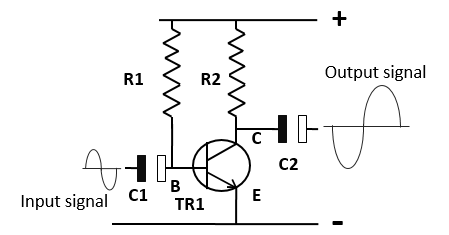
Here, it uses a common emitter configuration with the transistor properly biased with an R1 base resistor. It has a very small base current (normally 0.7V and 0.1mA). Now the collector is biased with R2(load resistor), which has much lower resistance than RB. So it has a much larger voltage than the base, and it must be biased towards the half voltage of the +vcc, so it can amplify both sides of the signal(+,-). Also, use some mile ampere (like 5V5mA).
Is more Now, if fed a signal (very small AC current — about 0.01V) with a C1 capacitor, the base signal now swings with a large collector, emitter electricity, which will give a much larger output signal via C2. This amplification amount highly depends on its beta value (bias with base). As this uses the common emitter method, the input phase changes (signal +,-) to reverse direction. That is because, if a base is more biased with positive, collector output connects more with negative and a base is more biased with negative, collector output connects more with positive. That’s why its output cycle reverses direction.
If you use transistor for amplification you must be carefully with its voltage, current and power rating, hfe value etc.
Transistor as a switch — Here, S1 connects to the base with an R1 resistor. Due to base bias, it will conduct current from the emitter to the collector. Simply the bulb connects with the negative to positive side like a close switch. It will cause the light the bulb(B). If S1 does not connect with the base, it doesn’t conduct any current from the emitter to the collector. Thus, the bulb nor light, as the bulb is never connected to a negative line. It’s like an open switch.
If you use a transistor as a switch, you must be careful with its maximum collector current and voltage amount. For high ampere (like 3A,5A etc.) circuits, you must fit a heat sink with it.
Logic circuits — Transistor switch can be used in various logic circuits like inverters.
Inhere, R1 connects with a positive 1V base, thus it will give logic low and, if it negative or lower than 0.2, it is like a open switch, thus output the same as VCC (here 5V).
For oscillators –
Oscillators are used for producing various frequencies in the circuits. Transistors are used as a one of the main component to make oscillators or multi-vibrators.
Simple multi vibrator with two transistors.