The capacitor is one of the basic components of electronic circuits. It is the part that is related to capacitance.

The main functions of capacitors are:
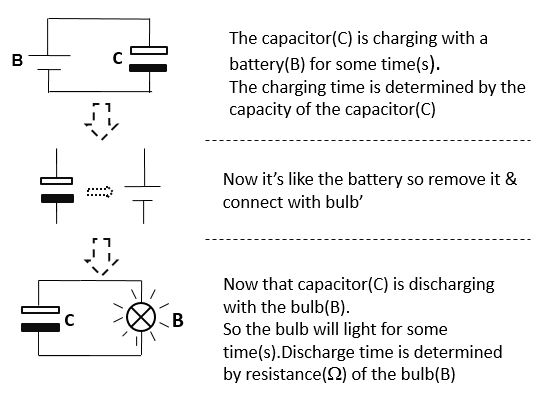
It can store electricity for a limited time.
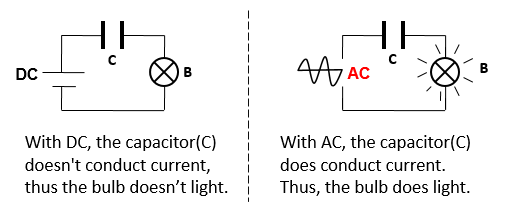
It can pass the AC while blocking DC.
Making of capacitor – Use two conductive metal plates like aluminum, copper around dialectic material such as ceramic, plastic, paper etc.
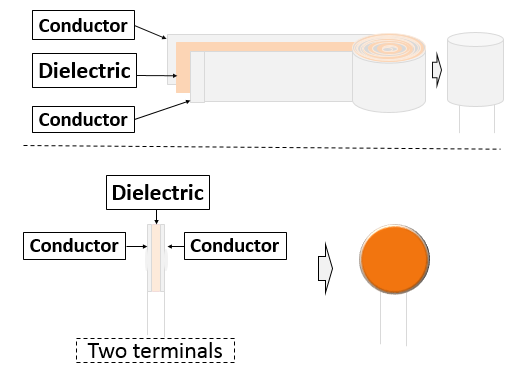
The capacitance of the capacitor and its highest voltage amount are determined by the size and material of the conductive layers and dialectic layer.
Specification of capacitor.
Capacitor has two terminals. It has capacitance, maximum voltage etc. When using a capacitor, you must be careful about some factors.
Capacitance — This is represented by the letter Farad. However, this is a very large value. So it is commonly used in smaller units of farad(F), like micro farad(uF), nano farad(nF) and pica farad(pF).
eg -1pf,2nf 22pf,1mfd, 100,220, 1000,4700 etc.More information later.
Every capacitor has its maximum voltage (V), which can work without damage or exploding its. So, if you use capacitors on the circuits, you must use capacitors that exceed their voltage.
E.g- Like, for 12V circuits it must be at least 16V.
Polarity of capacitors — Many capacitor types don’t have polarity. However, some capacitor types also have polarity, so positive and negative terminals must be used correctly. If not, it could explode or be destroyed. Therefore, these should be used cautiously in circuits.
Tolerance – Capacitor also have some tolerance percentage(%) like resistors which is value can be change a bit due to the temperature. However this is not critical for many usage.
There are two types: fixed and variable.
Fixed capacitor
fixed capacitor – Make only for one value. fixed capacitor types,
Ceramic – This is used as a ceramic insulator and uses two conductor coatings on either side. It has no main polarity and can commonly be seen in many circuits. Generally, it is made with a small capacity below 1uF.
Electrolytic – This capacitor is designed for large capacity(like 1-10000uF or more). It also has a polarity,
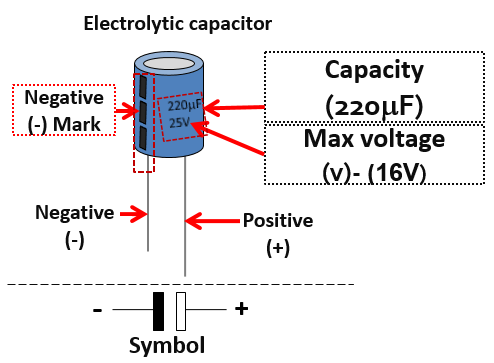
so whenever you use it, you must use it without changing the positive terminal and negative terminal , otherwise it will be explode & destroyed due to excessive heat. The conductor components here are chemically applied and operate only when electricity is present.Using this method it can be make for very large micro farad(uF) amount& some Farads(F).
Tantalum – It is based on tantalum. This type has a very low value change percentage compared to many others. It is extremely reliable and very expensive. Thus, it is used only where a very accurate value is needed. There is a polarity and must be installed correctly.
Variable capacitors
Variable capacitors – Can be changed capacity for a variety of values.Like if we take 500pF tuning capacitor it can change 0 – 500pF amount.
E.G – Tuning capacitors, trimmers etc.
These capacitors have two separate plate one is moving and other as fixed and used dielectric as air or thin plastic sheets. So when we turn tuning spindle which is connected to the moving plates it change the conductor space against the fixed plate. for large capacitors like tuning capacitors, it is connect to several plates parallel to each other.Variable capacitors also have two pins, however as tuning capacitor used for tuning radio channels for several band it must have several capacitor units so it can be many terminals.
How to identify the value of a capacitor — Normally, some capacitors, like electrolytic, directly display value. But many capacitors, like ceramic, polyester, paper etc., display them with a number system. More information later.
How to identify the max voltage(V) of a capacitor — Normally, any size electrolytic capacitor & any large capacitors directly display the maximum voltage value. But for small capacitors like ceramic, polyester which don’t display any voltage, the maximum voltage is 50V.
For safety- As capacitor can store electricity for limited time some large capacitor can still store even after power remove from the circuits. So extremely careful about it, when you service with high voltage(110 – 240v or more) electricity items without proper discharging.